

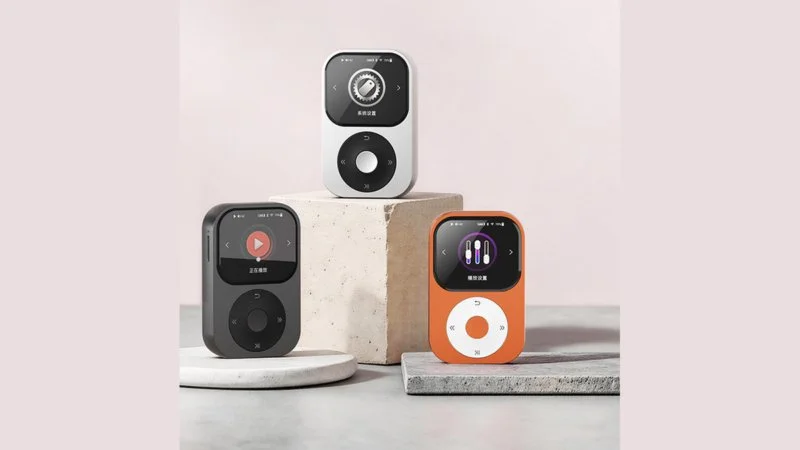
Shanling released the Q2, a compact portable player with four Cirrus Logic CS43131 DACs, a balanced 4.4mm output, and its own MTouch OS. In China, the model went on sale on August 4, 2026.
What the manufacturer claims:
- Four Cirrus Logic CS43131 DAC chips, four digital filter modes
- 3.5mm output: 30mW/32 Ohms on low gain and 120mW/32 Ohms on high (2V), output impedance less than 1.4 Ohms
- 4.4mm balanced output: 120mW/32 Ohms on low gain and 425mW/32 Ohms on high (3.7V), output impedance less than 1.8 Ohms
- PCM up to 768kHz/32bit and DSD512 for file playback; USB DAC mode up to 384kHz/32bit
- 1.9V RMS (3.5mm) and 3.8V RMS (4.4mm) line outputs, 20Hz–40kHz range at −1dB
- Dual-band Bluetooth 5.2 (LDAC, aptX HD, aptX, AAC, SBC) — the player can both receive and transmit signal to wireless earbuds
- 2.4/5 GHz Wi-Fi, built-in Tidal and Baidu Netdisk, DLNA, AirPlay, and QPlay support
- 2.09″ (375×320) touchscreen, plus physical buttons and a rotary control knob
- Ingenic X2000 processor, MTouch OS
- microSD cards up to 2TB (NTFS/FAT32/exFAT)
- Dimensions 80 × 50 × 13.5mm (14.2mm at the screen bump), weight 83g
- 1850mAh battery: up to 13.5 hours via 3.5mm, up to 12.5 hours via 4.4mm, up to 16.5 hours in Bluetooth transmitter mode with LDAC
Why this is interesting. Many modern players with Wi-Fi and streaming services are built on Android. Shanling chose its own MTouch OS — third-party apps are not supported, but the main network functions are present: Tidal, AirPlay, DLNA, QPlay, bidirectional Bluetooth, and USB Audio. The difference in power between the outputs (120 mW on 3.5 mm versus 425 mW on 4.4 mm at high gain) is due to the greater voltage swing of the balanced output — this is normal for a balanced circuit, not a feature of the four DACs.
What’s concerning. The official page doesn’t reveal the audio path diagram: how four CS43131s are distributed between channels and if the configuration changes when switching between outputs. Charging time and battery life measurement conditions aren’t specified. Only microSD cards are listed in the specs — nothing is said about user-accessible internal storage.
What’s inside
- 3.5mm and 4.4mm outputs, two gain levels
- Line out
- Wi-Fi + Tidal / AirPlay / DLNA / QPlay
- Two-way Bluetooth and USB Audio
- microSD up to 2TB, remote control via Eddict Player app
What’s missing
- Android — instead, it has MTouch OS
- Installing third-party apps is not supported
- The amount of built-in storage is not specified
- The four-chip audio path design is not disclosed
- Power output at 150/300 Ohms is not provided
- The global price and launch date have not been announced yet
Price and where to buy. In China, the retail price of the Shanling Q2 is $207 (1398 yuan), and the starting price is $186 (1258 yuan). Pre-orders opened on July 29 at 8:00 PM, and sales in the official Shanling flagship store on JD began on August 4 at 8:00 PM. The starting period will last until August 11 at 8:00 PM. Shanling has not yet announced the global price or the date of the international release.
What we’ll check in the test. Power and maximum voltage at 16, 32, 150, and 300 Ohm loads, background noise level with sensitive in-ear earbuds, and the difference between low and high gain. We’ll compare the 3.5mm and 4.4mm outputs at the same volume level — otherwise, the more powerful balanced output will seem subjectively better without a real difference in quality. Separately — actual battery life in three stated modes and the convenience of the touchscreen along with the rotary dial.
If you’re choosing a portable source for wired headphones, we have a rating of tested models for different budgets.
- Read also: Best MP3 players rating — TOP 15
Do we need a separate music player in 2026 when we can connect an external DAC to a smartphone? Write in the comments — I will gather your arguments for a review.
Source: Shanling — official Q2 page
