

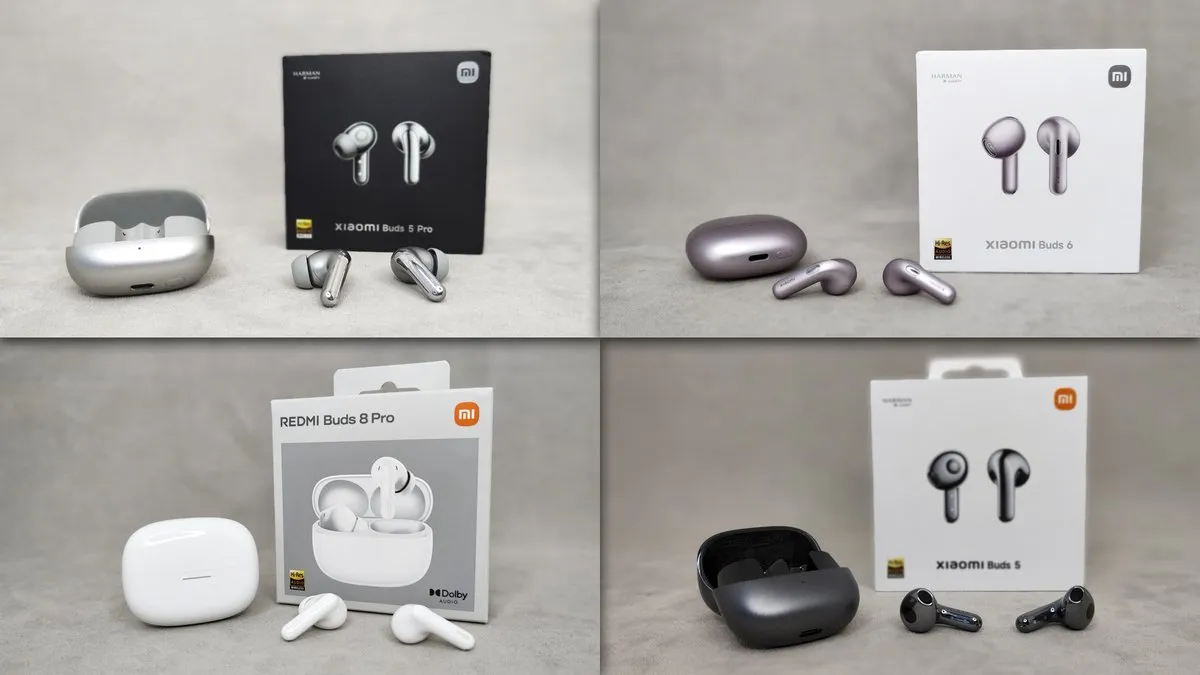
Xiaomi and Redmi earbuds aim for a sweet spot between price and quality. But with each new generation, that balance shifts: the earbuds get pricier, and the quality seems to dip. Still, Xiaomi sometimes surprises with unique features – like a built-in voice recorder, which you don’t see on many models.
In this roundup, we’ve compiled the top 4 best and most relevant wireless Xiaomi and Redmi earbuds. These are TWS earbuds available in two popular styles: open-fit and in-ear. All the Bluetooth earbuds in this list are versatile and work well for music, videos, gaming, and calls.
How do you get high-resolution codecs like LDAC, LHDC, aptX Adaptive, or aptX Lossless in wireless earbuds?
Learn moreIf your earbuds support a required codec but your phone, tablet, or PC doesn’t, you can use a USB adapter. This small Bluetooth adapter plugs into your phone or PC’s port, and your earbuds connect to the adapter, receiving the signal with the appropriate codec.
Which adapter to choose?
- QCC Dongle Pro2 – if you need everything at once. The adapter supports: LHDC 5.0, LDAC, aptX Adaptive, aptX HD, aptX Lossless; LE Audio and Auracast are declared.
- FiiO Air Link – a universal adapter, only cheaper. Codec support: SBC, aptX, aptX Low Latency, aptX HD, aptX Adaptive, LDAC, and aptX Lossless.
- 1Mii B03Pro – a desktop option with a transmitter and receiver. Supports: SBC, AAC, aptX, aptX HD, aptX LL, aptX Adaptive.
- UGREEN BT701 – a compact universal option. Codec support: Classic Bluetooth: SBC, aptX, aptX HD, aptX Adaptive-LL, aptX Adaptive-HQ. LE Audio: Auracast, Unicast-Low Latency, Unicast-Lossless.
- UGREEN BT501 – a simplified version of the BT701. Supports: SBC, aptX, aptX Low Latency, aptX HD, aptX Adaptive.
Check out our ranking for more on USB adapters — Best Bluetooth Adapters for Computers and Earbuds.
Learn more about the LDAC codec, relevant for all low-compression codecs: compatibility, real quality improvement, where the codec works, etc.
Learn moreThe LDAC codec was developed by Sony and is used in most of the manufacturer’s proprietary audio equipment.
Compatibility. The LDAC codec is the second most common high-res audio codec on Android after AAC and SBC. LDAC offers less compressed, more detailed sound, with the best quality achieved using the ‘quality’ preset at a 909/990 Kbps bitrate. It’s been available since Android 8.0 and is supported by most phones and tablets, excluding some models where manufacturers have removed it or locked it in hardware. So, in 99.9% of cases, an Android device will be compatible with earbuds supporting LDAC.
Impact on Sound: Expectation vs. Reality. Many potential owners of LDAC-equipped earbuds mistakenly believe the codec guarantees high-quality sound. The equation ‘source with LDAC’ + ‘earbuds with LDAC’ = ‘high-quality sound’ doesn’t always hold true. The codec acts as a ‘data packer,’ and its effectiveness depends on how well data is unpacked. The actual sound system plays the crucial role: driver type and number, driver design, DAC and amplifiers, acoustic design, and other internal components. If any part of this system is compromised by cost-saving measures or design flaws, the codec’s potential is diminished. It’s simple: if the sound system can’t handle it, the codec won’t make up for it.
Where LDAC Makes a Difference. Typically, earbuds under $50 don’t benefit much from LDAC, or the improvement is minimal. You’re more likely to notice a significant improvement in earbuds priced at $100 or more.
You’ll often find a more noticeable quality improvement in mid-range models and up. Lower production costs inherently mean more limitations. However, a high price doesn’t always guarantee superior quality; some expensive models have low production costs with high markups that benefit shareholders or celebrities. This means there are exceptions, both in cheaper and more expensive models.
Real Improvement with LDAC. Based on my experience testing earbuds with various driver types and designs, the improvement ranges from about 1-3% to 15-20%. These are approximate figures, as my tests rely on listening. I haven’t encountered any devices for objective quality measurement.
It’s important to understand 2 main points. First, with the LDAC codec, you get an improvement in detail retrieval. Naturalness doesn’t improve, nor does the soundstage. The sound balance also doesn’t change.
Furthermore, the percentage improvement varies for each pair of earbuds. A 15-20% boost in earbuds scoring 5-6 out of 10 isn’t comparable to a 3-5% improvement in earbuds scoring 8-9. So, when you notice a significant improvement with the codec, it’s worth considering the overall sound score of the earbuds.
Which codec is better – LDAC or LHDC?
Learn moreIn terms of availability, LDAC is better; in terms of capabilities, LHDC is better.
| Maximum bitrate | Up to 990 kbps | Up to 900 kbps (V 3/4), up to 1000 kbps (v5) |
| Maximum frequency / Bitrate | 24 bit / 96 kHz | 24 bit / 96 kHz (v3/v4), up to 24 bit / 192 kHz (v5) |
| Bitrate control | 330 / 660 / 990 kbps, adaptive bitrate – 330-990 kbps. | 400 / 500 / 900 / 1000 kbps, adaptive bitrate – 128-1000 kbps. |
| Audio latency | ~160–200 ms | ~200 ms (there is an LLAC / LHDC LL mode with low latency up to 30 ms |
| Integration into Android | Native support with Android 8.0+ | Basic structure in AOSP with Android 10, native support v5 with Android 17 |
| Lossless mode | No | LHDC 5.0 claims lossless |
The characteristics of both codecs are comparable, with more in favor of LHDC. More tuning parameters are available, higher sampling frequency, there are LHDC lossless and audio latency reduction switches.
However, LDAC is far more prevalent. Since it’s been in Android 8.0+, compatibility isn’t usually an issue. More earbuds across various price points support LDAC, and more USB adapters are available for it. For comparison, only two USB adapters support LHDC, and just one works reliably. LHDC might catch up to LDAC in prevalence, possibly even surpass it, as its more flexible licensing and minimal royalty fees could quickly popularize it among manufacturers.
In terms of signal stability, both codecs are on the same level.
When it comes to sound quality, both codecs offer pretty much the same experience; you’d have to listen very closely to tell the difference, assuming the earbuds support both LDAC and LHDC. So, you should prioritize the sound hardware first, then worry about the codec. Learn more about codecs here.
Which codec is better – aptX, aptX HD, aptX Adaptive, or aptX Lossless?
Learn moreComparative table of main codec parameters:
| Launch year | < 2009 | 2016 | 2018 | 2021 |
| Bitrate | 352 kbps | 576 kbps | 279–420 kbps (dynamic) | ~1.1–1.2 Mbps (dynamic, up to 860 kbps lossy + lossless layer) |
| Bit depth | 16-bit | 24-bit | 16 / 24-bit | 16 / 24-bit |
| Sampling frequency | 44.1 / 48 kHz | 44.1 / 48 kHz | 44.1 / 48 / 96 kHz | 44.1 / 48 / 96 kHz |
| Compression type | Lossy (4:1) | Lossy (4:1) | Lossy (5:1–10:1, adaptive) | Lossless CD (16/44.1) + lossy Hi-Res |
| Signal latency | ~150–200 ms | ~150–200 ms | ≈ 50–80 ms | ~80 ms |
| aptX Voice | No | No | Yes | Yes |
From the table, it’s not hard to understand – aptX Lossless is the best codec. However, aptX Lossless is not a standalone codec but an add-on for aptX Adaptive. There is no choice of sound quality parameters in Android settings, and aptX Lossless itself only activates under specific conditions:
- Requires support for Snapdragon Sound on both the phone and earbuds.
- Clear airwaves – no Bluetooth and Wi-Fi interference.
- aptX Lossless option enabled – if such an option exists in the phone’s settings.
If the conditions are not met, and having only one SoC with aptX Lossless support is not enough, then the sound is transmitted via the aptX Adaptive codec. The aptX Adaptive codec also activates in the presence of interference. Neighboring Wi-Fi hotspots in apartment buildings are often sufficient.
More about audio codecs.
Xiaomi earbuds fall into two main camps: flagship and budget. The best sound, microphones, and other advanced features are reserved for the flagship models, which come with a matching price tag. Budget models typically cost under $50, with corresponding sound and features. It’s easy to tell them apart: flagship earbuds carry the Xiaomi brand, while budget ones use the Redmi brand. You’ll often see budget models referred to as Xiaomi Redmi earbuds.
TOP 4 Best Xiaomi Earbuds 2026 – Wireless and Wired Ranking:
1. Xiaomi Buds 5 Pro 7.57In-ear noise-canceling earbuds – good for Android
Drivers are the drivers in your headphones that are responsible for creating sound.
DD + PM + BA – means that there are several different types of drivers in these headphones.
DD – “Dynamic Driver” dynamic driver (deep bass, natural sound).
PM – “Planar Magnetic Driver” planar driver (wide soundstage and fast response).
BA – “Balanced Armature Driver” armature driver (accuracy and detail retrieval).
BC – “Bone Conduction Driver” or bone-conduction driver, which transmits vibration to the body of the headphones, transmitting sound through the bone/cartilage to the inner ear.
LDAC – high quality, high speed (Sony).
SBC is the basic Bluetooth standard, low quality.
AAC – Apple standard, good quality, low latency.
aptX – Qualcomm standard, good quality, low latency.
LC3/LC3plus – new Bluetooth LE Audio codecs, efficient compression.
Codecs are audio compression formats that affect sound quality and latency.
Headphone battery life is the playback time without recharging, measured in hours. Manufacturers measure without active noise cancellation (ANC), at medium volume (50-70%) and usually with the AAC codec, as these parameters affect battery consumption. Actual time may vary from 1% to 50%, depending on volume, active noise cancellation features enabled, codec (LDAC or other) and environmental conditions (cold, hot). It is important to consider not only the claimed playback time, but also the charging time and fast charging support.
Bluetooth is a wireless data transmission standard.
Support for new audio technologies.
Improved connection stability.
Reduced power consumption.
The main reasons to buy these are the top-tier active noise cancellation, an excellent microphone in quiet environments, and that built-in voice recorder. On the downside, the sound is a bit above average, and the controls are awkward. The translator and higher bitrate features only work with specific Xiaomi phones. Plus, the charging case feels like it should cost about $20-25.
- Top-tier active noise cancellation
- Top-tier microphone in quiet conditions
- Built-in voice recorder
- Sound quality is slightly above average
- Inconvenient controls
- Translator and several other features are only available on select Xiaomi devices
The final sound score is calculated using this formula:
Frequency balance + Detail retrieval + Soundstage + Natural timbre / 4 = Final Sound Score.
. 7.25 The earbuds feature decent mids and highs, natural timbre, and detail retrieval. The main drawback of the sound signature is a heavy emphasis on the lows and a narrow soundstage. The sound is somewhat unnatural with a bass-heavy tone. This can be partially fixed using the EQ.Read more.
Microphone – We assess speech transmission quality by testing the microphone in two main scenarios: quiet and noisy environments.
Quiet environment – This involves recording indoors with minimal background noise. Noisy environment – This means recording outdoors near a six-lane road with maximum traffic noise.
. 7.75 In quiet conditions: 9 In noisy conditions: 6.5Overall feature score — this is the overall score for all device features. This score comes from individual feature ratings (battery life, controls, app, connection stability, and others) and shows how easy and smart the device is for daily use.
. 8.00 Active noise cancellation is top-tier and falls just slightly short of reference models. The transparency mode is worse, though you can still have a conversation. Battery life in our tests reached up to 8 hours and 48 minutes for the earbuds and 42 hours with the charging case. Controls support 5 actions per earbud, executed via pinch gestures on the stem — which is inconvenient. The companion app is not overloaded with junk features and includes useful ones, such as a voice recorder.Read more.
Final build quality score is the overall score for build quality and materials: comfort, durability, and design. It shows how nice the device is to hold and use, and how long it will last.
. 7.73 The earbuds are comfortable with the included ear tips. Fatigue sets in after a couple of hours. Build quality and materials are solid — though the case feels a bit “flimsy”, and the materials clearly feel cost-cut. The earbuds look good without causing any particular excitement.Read more.
2. Xiaomi Buds 6 7.47Open-fit earbuds with map search
Drivers are the drivers in your headphones that are responsible for creating sound.
DD + PM + BA – means that there are several different types of drivers in these headphones.
DD – “Dynamic Driver” dynamic driver (deep bass, natural sound).
PM – “Planar Magnetic Driver” planar driver (wide soundstage and fast response).
BA – “Balanced Armature Driver” armature driver (accuracy and detail retrieval).
BC – “Bone Conduction Driver” or bone-conduction driver, which transmits vibration to the body of the headphones, transmitting sound through the bone/cartilage to the inner ear.
LDAC – high quality, high speed (Sony).
SBC is the basic Bluetooth standard, low quality.
AAC – Apple standard, good quality, low latency.
aptX – Qualcomm standard, good quality, low latency.
LC3/LC3plus – new Bluetooth LE Audio codecs, efficient compression.
Codecs are audio compression formats that affect sound quality and latency.
Headphone battery life is the playback time without recharging, measured in hours. Manufacturers measure without active noise cancellation (ANC), at medium volume (50-70%) and usually with the AAC codec, as these parameters affect battery consumption. Actual time may vary from 1% to 50%, depending on volume, active noise cancellation features enabled, codec (LDAC or other) and environmental conditions (cold, hot). It is important to consider not only the claimed playback time, but also the charging time and fast charging support.
Bluetooth is a wireless data transmission standard.
Support for new audio technologies.
Improved connection stability.
Reduced power consumption.

The Xiaomi Buds 6 are essentially a repeat of the previous generation, with a few tweaks: slightly better sound balance, less sensitivity to the audio source, and a more refined noise-canceling mode. Controls and the microphone see minor improvements, putting them on par with reference standards. Honestly, the previous generation isn’t much worse. Most other changes are cosmetic, and battery life has actually decreased. The voice recorder functionality is unchanged, and the translator still only works with Xiaomi devices. Given all this, the previous generation looks like a better deal, especially considering the $120-160 price range.
- Voice recorder with 180 min. of recording time.
- Find earbuds via Apple Find My and Find Hub.
- Microphone close to reference quality
- Low sound detail retrieval.
- Translator works only on Xiaomi devices.
- The noise cancellation mode feels weak, and there is no transparency mode.
The final sound score is calculated using this formula:
Frequency balance + Detail retrieval + Soundstage + Natural timbre / 4 = Final Sound Score.
. 7.44 Everything sounds a bit muffled, lacking transparency right across the frequency spectrum. Detail retrieval is good enough to pick out main and background parts, but listening to anything else takes real focus. Its strongest point is its naturalness, since sound flaws are tough to spot. Xiaomi Buds 6 currently sit in the MyChooz bronze league, meaning a couple of strong competitors could easily push them down the rankings.Read more.
Microphone – We assess speech transmission quality by testing the microphone in two main scenarios: quiet and noisy environments.
Quiet environment – This involves recording indoors with minimal background noise. Noisy environment – This means recording outdoors near a six-lane road with maximum traffic noise.
. 9.25 In quiet conditions: 9.5 In noisy conditions: 9 The microphone matches the performance of the previous generation, though you will notice a genuine improvement in noisy environments thanks to better voice isolation.Read more.
Overall feature score — this is the overall score for all device features. This score comes from individual feature ratings (battery life, controls, app, connection stability, and others) and shows how easy and smart the device is for daily use.
. 7.24 Performance lands squarely in the average tier. There’s no transparency mode, and noise cancellation is only average—assuming you manage to wedge the earbuds tightly against your ear canals. Controls feel slightly improved over the previous generation, while the standout perks include a solid microphone, a built-in voice recorder with call recording, a handy app, and a reliable connection.Read more.
Final build quality score is the overall score for build quality and materials: comfort, durability, and design. It shows how nice the device is to hold and use, and how long it will last.
. 7.90 Lightweight and compact with no manufacturing flaws, though the finish acts like a magnet for fingerprints and smudges show up easily. Both the case and earbuds also tend to feel slippery when your hands are dry. Still, the earbuds remain comfortable and don’t cause any strain even after a couple of hours of continuous use.Read more.
3. Xiaomi Buds 5 7.47Bluetooth TWS open-fit earbuds – with voice recorder
Drivers are the drivers in your headphones that are responsible for creating sound.
DD + PM + BA – means that there are several different types of drivers in these headphones.
DD – “Dynamic Driver” dynamic driver (deep bass, natural sound).
PM – “Planar Magnetic Driver” planar driver (wide soundstage and fast response).
BA – “Balanced Armature Driver” armature driver (accuracy and detail retrieval).
BC – “Bone Conduction Driver” or bone-conduction driver, which transmits vibration to the body of the headphones, transmitting sound through the bone/cartilage to the inner ear.
LDAC – high quality, high speed (Sony).
SBC is the basic Bluetooth standard, low quality.
AAC – Apple standard, good quality, low latency.
aptX – Qualcomm standard, good quality, low latency.
LC3/LC3plus – new Bluetooth LE Audio codecs, efficient compression.
Codecs are audio compression formats that affect sound quality and latency.
Headphone battery life is the playback time without recharging, measured in hours. Manufacturers measure without active noise cancellation (ANC), at medium volume (50-70%) and usually with the AAC codec, as these parameters affect battery consumption. Actual time may vary from 1% to 50%, depending on volume, active noise cancellation features enabled, codec (LDAC or other) and environmental conditions (cold, hot). It is important to consider not only the claimed playback time, but also the charging time and fast charging support.
Bluetooth is a wireless data transmission standard.
Support for new audio technologies.
Improved connection stability.
Reduced power consumption.
The Xiaomi Buds 5 are Bluetooth TWS open-fit earbuds FEaturing a reference-level microphone and a 3-hour voice recorder. Using the aptX Adaptive codec offers a 10-15% quality improvement, and aptX Lossless boosts that by another 10%. A significant drawback is the frustratingly clunky controls.
- Best sound under $80 with EQ
- Reference-quality microphone
- Voice recorder for 3 hours of recording
- Awkward pinch controls on the earbud stem
- Voice recordings longer than 60 min. cannot be transferred
- Sound varies across different sources
The final sound score is calculated using this formula:
Frequency balance + Detail retrieval + Soundstage + Natural timbre / 4 = Final Sound Score.
. 7.67 Sound testing was handled across three different phones. One source leaned heavily into bass, giving the presentation a slightly boomy character, while another emphasized the highs, making the sound a bit harsh and colored. In both cases, the built-in EQ lets you straighten things out. Vocals and instruments come through clean, pleasant, and quite natural, though the highs carry a touch of artificial timbre. The soundstage stretches slightly wider than your head, but dense mixes still cause detail retrieval to take a hit.Read more.
Microphone – We assess speech transmission quality by testing the microphone in two main scenarios: quiet and noisy environments.
Quiet environment – This involves recording indoors with minimal background noise. Noisy environment – This means recording outdoors near a six-lane road with maximum traffic noise.
. 8.75 In quiet conditions: 9.5 In noisy conditions: 8 In quiet conditions, the microphone performs very well, making your voice sound detailed and clear. The recording quality even beats our reference Huawei FreeBuds Pro 4. But in noisy environments, like next to a 6-lane road, quality drops noticeably and it gets harder to make out your voice. You get this exact same recording quality when using the voice recorder mode.Read more.
Overall feature score — this is the overall score for all device features. This score comes from individual feature ratings (battery life, controls, app, connection stability, and others) and shows how easy and smart the device is for daily use.
. 6.79 Noise cancellation comes close to matching top-tier models, though a transparency mode is missing. Battery life meets expectations, hitting up to 7 hrs. 23 min. for the earbuds and up to 40 hrs. total with the case in our tests. Pinch controls along the earbud stem feel awkward and trigger inconsistently, but the companion app proves genuinely useful and convenient. The wireless signal holds without dropping inside a 10m radius.Read more.
Final build quality score is the overall score for build quality and materials: comfort, durability, and design. It shows how nice the device is to hold and use, and how long it will last.
. 8.00 The earbuds are lightweight, though ear fatigue creeps in after a couple of hours. Build quality and materials are top-notch, though the finish attracts plenty of fingerprints. They come in 4 colors and look fine without being particularly exciting.Read more.
4. Redmi Buds 8 Pro 7.27Best Budget Xiaomi Wireless Earbuds – with good features
Drivers are the drivers in your headphones that are responsible for creating sound.
DD + PM + BA – means that there are several different types of drivers in these headphones.
DD – “Dynamic Driver” dynamic driver (deep bass, natural sound).
PM – “Planar Magnetic Driver” planar driver (wide soundstage and fast response).
BA – “Balanced Armature Driver” armature driver (accuracy and detail retrieval).
BC – “Bone Conduction Driver” or bone-conduction driver, which transmits vibration to the body of the headphones, transmitting sound through the bone/cartilage to the inner ear.
LDAC – high quality, high speed (Sony).
SBC is the basic Bluetooth standard, low quality.
AAC – Apple standard, good quality, low latency.
aptX – Qualcomm standard, good quality, low latency.
LC3/LC3plus – new Bluetooth LE Audio codecs, efficient compression.
Codecs are audio compression formats that affect sound quality and latency.
Headphone battery life is the playback time without recharging, measured in hours. Manufacturers measure without active noise cancellation (ANC), at medium volume (50-70%) and usually with the AAC codec, as these parameters affect battery consumption. Actual time may vary from 1% to 50%, depending on volume, active noise cancellation features enabled, codec (LDAC or other) and environmental conditions (cold, hot). It is important to consider not only the claimed playback time, but also the charging time and fast charging support.
Bluetooth is a wireless data transmission standard.
Support for new audio technologies.
Improved connection stability.
Reduced power consumption.

Beyond noise cancellation and the microphone, there’s little reason to pick up the Redmi Buds 8 Pro. The sound profile is unappealing, battery life is just okay, and they lack any standout features like triple multipoint or a translator. Even the HAYLOU Flowbuds N55, despite costing 2.5 to 3 times less, sound more engaging after a firmware update and aren’t far behind in noise cancellation depth. At $20-30, you might consider Redmi earbuds if your budget is extremely tight. For $50-70, however, you can definitely find better options.
- Solid sound for the price after EQ tuning
- Noise cancellation is enough to block out street and office noise
- Immersive transport ride mode
- Top-tier microphone in quiet conditions
- Out-of-the-box sound is fatiguing quickly, with a muddy mid-range and a narrow soundstage.
- The LDAC codec drops regularly.
- Poor transparency mode.
The final sound score is calculated using this formula:
Frequency balance + Detail retrieval + Soundstage + Natural timbre / 4 = Final Sound Score.
. 6.96 The strong side of the Redmi Buds 8 Pro sound is the lows; they are punchy, with a readable structure, and the sound grooves. This is pretty much the only strong side. Otherwise, the mids are pushed back. The highs are rather dull, although not pushed back. Detail retrieval is average, and naturalness has its issues as well. The soundstage is a bit narrow, and while not terrible, for $65 you expect a result at least on par with the basic Realme 8. As a result, this is solid sound, on par with a typical $50-60 model, MyChooz wood league, falling just slightly short of the bronze league. However, with EQ tuning, it reaches the bronze league.Read more.
Microphone – We assess speech transmission quality by testing the microphone in two main scenarios: quiet and noisy environments.
Quiet environment – This involves recording indoors with minimal background noise. Noisy environment – This means recording outdoors near a six-lane road with maximum traffic noise.
. 8.75 In quiet environments: 9.5 In noisy environments: 8Overall feature score — this is the overall score for all device features. This score comes from individual feature ratings (battery life, controls, app, connection stability, and others) and shows how easy and smart the device is for daily use.
. 7.75 The microphone on the Redmi Buds 8 Pro performs adequately for the $60-70 price tag. Strengths. Active noise cancellation blocks noise effectively. Battery life matches the specs and the Chinese version: 8.5 hours for the earbuds and 35 hours with the charging case. The companion app matches the reference standard, is user-friendly, and includes all useful features. Weaknesses. Transparency mode is uncomfortable, making you want to take the earbuds off to talk. Touch controls are solid, though double and triple taps sometimes misfire. The LDAC connection drops frequently, even with adaptive bitrate.Read more.
Final build quality score is the overall score for build quality and materials: comfort, durability, and design. It shows how nice the device is to hold and use, and how long it will last.
. 7.33 The earbuds are comfortable with the included ear tips. Build quality and materials have no faults, though the glossy plastic is a fingerprint magnet and scratches easily. The earbuds look solid, with 3 colors to choose from.