

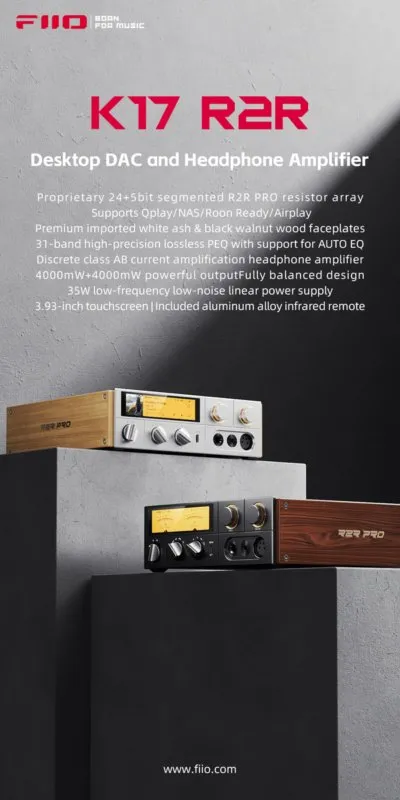
FiiO has released the K17 R2R, a desktop DAC, network player and headphone amplifier with a proprietary resistor array. The device is built on the platform of the regular K17, but instead of the AKM AK4191EX and two AK4499EQ chips it uses FiiO’s own development: a segmented R2R PRO resistor array with 24+5 bit resolution.
The amplifier section has not changed. The output stage remains discrete, built on ON Semi MJE243G and MJE253G transistors exactly as in the regular K17, and the touchscreen, the network features and the equaliser have also carried over from the platform without changes. Visually the new version differs by its side panels made of solid wood.
- Proprietary segmented R2R PRO resistor array with 24+5 bit resolution instead of a bought chip
- Balanced output: 4000 mW of power per channel is declared, the load impedance is not stated on the page
- Side panels of solid wood: white ash on the silver version, black walnut on the dark one
- The whole K17 platform: a 3.93-inch screen, Roon Ready, AirPlay, QPlay, playback from network storage over NFS and SMB
- A 31-band parametric equaliser with Auto EQ support
The array. Instead of the AKM delta-sigma chip, the digital signal here is converted by a resistor ladder that FiiO assembled itself. The circuit is declared as segmented: a 24-bit array plus a separate 5-bit section that is meant to reduce error accumulation. Such an architecture demands high precision of component values and correction at low signal levels, so the question is not the array itself but what the measurements will show.
Power. FiiO declares a power of 4000 mW per channel over the balanced output and compares the device with the K9 Pro ESS, promising almost double the figure. The load impedance is not named on the K17 R2R page, and without it the number means little: in the specification table of the regular K17 the same 4000 mW are given at a 32 Ω load, while at 300 Ω only 950 mW of power remain. The amplifier section is shared between the versions, but I will still check the headroom with high-impedance headphones by ear.
K17 R2R
- Proprietary R2R PRO array, 24+5 bit
- Side panels of solid wood
- Balanced: 4000 mW declared, load not named
- 3.93-inch screen
K17
- AKM AK4191EX and two AK4499EQ chips
- Housing without wooden side panels
- Balanced 4000 mW at a 32 Ω load
- 3.93-inch screen
In functions and in the amplifier section the versions are practically identical: one declared power figure, one screen, one platform, one discrete stage. There are exactly two differences — the digital-to-analogue conversion and the wood on the sides. FiiO does not publish the price on the product page.
What I will check. The two versions have to be compared in one chain and at matched volume, otherwise a difference that does not exist will seem to appear. In the test I will check whether the difference is audible at precise matching, what the OS and NOS modes change, whether there is noise with sensitive in-ear headphones, how the device copes with a 300 Ω load, and whether the versions diverge in staging and attack or only in tonal balance. Read also our story about the FiiO Echo Nano: that one is also a source, but a pocket player that runs on a single bought DAC chip.
What would you choose at an equal price — a bought chip or the brand’s own array? Tell us in the comments, especially if you have listened to both schemes on the same headphones.
Source: www.fiio.com
