

SIVGA unveiled the Lyrebird at CanJam London on July 15 — wired in-ear monitors (IEM) that pack four different driver types in each earpiece. Price — $149.
I know the brand firsthand: Sasha Chernov reviewed the full-size Robin and P2 Pro, the in-ear SM100 and Que. I use moded first-gen Robins on a daily basis. SIVGA’s signature is always the same — wood and sound for sensible money. The Lyrebird is their move into a complex multi-driver hybrid.
The most interesting about the SIVGA Lyrebird
- Drivers: four types in each earpiece — 10mm dynamic, balanced armature, micro-planar, 9.2mm piezoelectric ceramic
- Housing: CNC aluminum, stabilized-wood faceplates (resin-treated against moisture)
- Drive: 14Ω, 108dB — enough even for listening from a phone
- Cable: detachable hybrid (Furukawa copper + silver), 2-pin, 4.4mm balanced plug
- In the box: Crazy Horse leather case, 7 pairs of ear tips
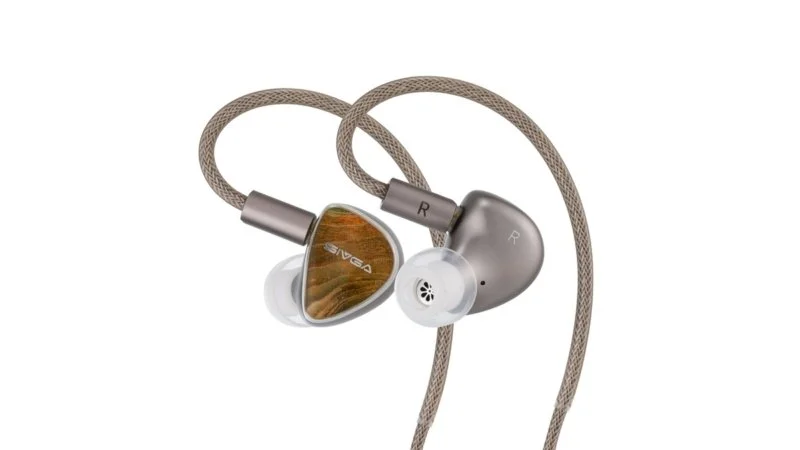
Drivers. The Lyrebird’s main selling point and a reason for skepticism. The logic is simple: each driver type covers its own range — the dynamic handles bass, the armature vocals and mids, the micro-planar the treble, the piezoceramic the ultra-highs. On paper — an orchestra. In practice, multi-driver hybrids live or die on the crossover (the circuit that splits frequencies between drivers): stitch it badly and you get dips and mush at the seams. Four drivers ≠ automatically better than two. How SIVGA blended them — testing will tell.
Wood. Stabilized faceplates are SIVGA’s signature. Ordinary wood fears moisture and warps; stabilized wood is resin-impregnated, hard and sweat-proof. For me that’s their thing: headphones that look like a quality object and hold their looks for years.
Source requirements. 14Ω and 108dB — low impedance and high sensitivity. In plain terms: the Lyrebird plays loud even from a phone dongle, without a separate amp. For a $149 IEM that’s fair — not forcing you to pay extra for a dongle.
Cable. Detachable, 2-pin. The plug is 4.4mm balanced out of the box — that’s for those with a balanced output on their player; a regular 3.5mm needs an adapter. A detail worth knowing before you buy.
Price. $149 — mid-tier for an audiophile entry into hybrids. For comparison: the SIVGA SM100 — same roots but simpler and three times cheaper ($43); and the DUNU x Gizaudio DaVinci hybrid ($299) — twice as expensive.
I’ve been following SIVGA for a while, and I want to test this Lyrebird. Tell me in the comments whether to take it for a full review and into the wired-IEM ranking. Subscribe to MyChooz on Telegram and YouTube so you don’t miss the review, if it happens.
Source: SIVGA official store
