

Soundcore just released the Boom Go 3i — a compact speaker for $80. That’s exactly what JBL Clip 5 costs, the speaker that’s owned this niche for two years. Except the Boom Go 3i packs twice the wattage, IP68 instead of IP67, Bluetooth 6.0, and a built-in power bank. On paper, it looks very compelling. Here’s what’s interesting about this new little speaker.
- Power: 15W vs 7W on Clip 5 — double the output for the same price
- Protection: IP68 vs IP67 — both dust-proof, but IP68 survives deeper submersion
- Bluetooth 6.0 vs 5.3 — both with Auracast
- Battery: 24h vs 12h (15h with Playtime Boost) — double the base runtime
- Power bank: charges your phone via USB-C (Clip 5 can’t do this)
- RGB: 14 lighting modes (Clip 5 has none)
- Drop-test: survives 1m drops (Clip 5 — not rated)
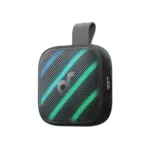
Sound. 15W with BassUp 2.0 — peak loudness of 92 dB, while JBL Clip 5 runs 7W. A twofold difference in wattage is usually noticeable, especially outdoors. Boom Go 3i looks more impressive by the numbers. That said, watts ≠ sound quality. And in real-world tests, the picture often changes dramatically. We’ll test this.
Protection. IP68 and IP67 — both fully dust-proof (the 6 digit). The difference is only in water: IP67 = submersion up to 1m for 30 min, IP68 = deeper and longer. In practice, both will survive a shower and rain. But Boom Go 3i also has a 1-meter drop-test rating — Clip 5 doesn’t promise that. Although from my personal testing, the Clip 5 is pretty much unkillable.
Bluetooth. Both support Auracast — a broadcast standard where one speaker streams audio and others pick it up. The difference is in version: Boom Go 3i — BT 6.0, Clip 5 — BT 5.3. Version 6.0 is more energy-efficient and more stable at distance. Boom Go 3i also works as a voice amplifier via Bluetooth — handy for picnics.
Battery. 24 hours with BassUp vs 12 hours on Clip 5 (15h with Playtime Boost, which cuts the bass). In Eco Mode, Boom Go 3i plays up to 40 hours. Plus a power bank via USB-C (4800 mAh) — it’ll charge your phone. Clip 5 doesn’t have a power bank function.
Clip 5. But JBL has its own advantages. The carabiner is built-in — clips onto a backpack with one hand. Boom Go 3i is heavier: 380g vs 290g for Clip 5. And most importantly — JBL sounds good. Clip 5 is proven by two years of reviews, while Boom Go 3i is an unproven newcomer (which we’ll definitely put to the test). And of course, watts don’t equal quality, and watts on a spec sheet don’t equal watts in reality — there’s a lot of manipulation around this in portable audio.
RGB. 14 lighting modes: 6 react to music, 8 ambient. Emergency alarm at 92 dB — audible from 50 meters. Clip 5 has no lighting at all.
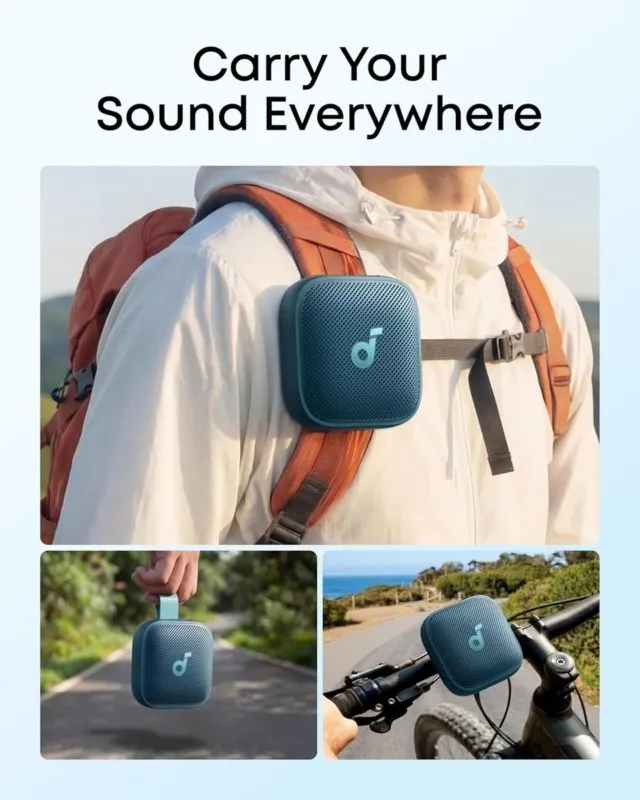
Boom Go 3i ($80)
- Power: 15W, 92 dB
- Bluetooth 6.0 + Auracast
- Battery: 24h / 40h Eco
- IP68 + 1m drop-test
- Power bank: yes
- RGB: 14 modes
- Weight: 380g
JBL Clip 5 ($80)
- Power: 7W
- Bluetooth 5.3 + Auracast
- Battery: 12h / 15h (Playtime Boost)
- IP67
- Power bank: no
- RGB: no
- Weight: 285g (carabiner)
Clip 5 or Boom Go 3i — which would you pick? Drop a comment
On paper, Boom Go 3i beats Clip 5 almost everywhere: double the power, 9 extra hours of battery, IP68, power bank, RGB. Clip 5 is 90g lighter and battle-tested. For $80, Soundcore offers more on the spec sheet — but how it actually sounds, our test will show.
Source: soundcore.com
