

The TOP microphone boom arms for 2026 includes the 4 best microphone stands I’ve tested over the last few years and one that I now use on a permanent basis.
To choose the best boom arm, I’ll highlight 3 main parameters: reliable desk mounting, reliable microphone position locking, and durability. But I went even further, and the TOP microphone boom arms for 2026 are ranked based on an evaluation of all primary and secondary selection parameters for the best boom arms. Here are those parameters: mount, frame, adjustment nodes, construction size, accessory mounting, cable management, microphone holder, ease of use.
What is a boom arm? It’s a device with an articulated structure used to mount various items: microphones, cameras, or lighting equipment. The main task of a boom arm is to provide flexibility and convenience in adjusting the position of the mounted object.
Choosing a microphone boom arm (stand) – desktop, for all types of microphones:
1. Fifine BM88
Best microphone boom arm for FiFine and other brands – for computers and streams
Microphone Mount: threaded 1/4”, 3/8”, and 5/8” | Load capacity: 1.5 kg | Length: 64 cm | Position Lock: Allen key
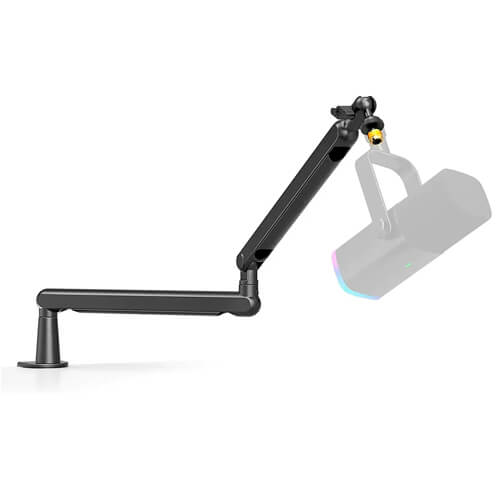

Fifine BM88 ($41) – a universal microphone boom arm for FiFine and other manufacturers with 1/4”, 3/8”, 5/8” threads. Such a boom arm is an ideal solution if you need to position a microphone in the frame during a stream or video recording.
Boom Arm Rating – 8.6/10. The Fifine boom arm is sturdy and reliable in use, and the construction is stable under load. The stand can support the weight of a microphone or other equipment up to 1.5 kg and offers smooth movement when changing position. The BM88 boom arm is compact and will fit perfectly in environments with limited workspace. A drawback is that the microphone boom arm requires manual tightening of the articulated joints with a 6-sided wrench. And the main microphone mount is not sold separately, so it’s important not to lose the mount or individual parts.
- Strong, reliable, and durable mount.
- Mounting of the stand from the bottom and top.
- Strong and reliable construction.
- Withstands a load of up to 1.5 kg.
- Compatible with all microphones with 1/4'', 3/8'', 5/8'' threads.
- Compact dimensions.
- Mounting only for flat surfaces without curves or edges.
- A 6-sided wrench is required to fix the hinges.
- Microphone mounts are not sold separately.
2. Thronmax Zoom S3-TM01
Best microphone boom arm (stand) – for studio, condenser microphones
Microphone Mount: threaded 1/4”, 3/8”, and 5/8” | Load capacity: 1 kg | Length: 90 cm | Position Lock: knob on the body
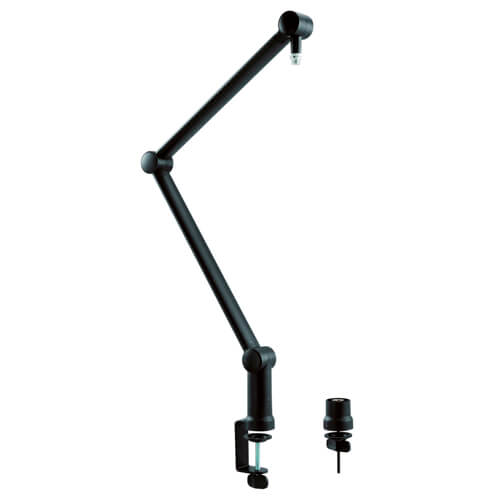
Thronmax Zoom S3-TM01 ($65) – a universal premium-level microphone stand for any microphone with 1/4”, 3/8”, 5/8” threads. The boom arm looks great on camera, and the 90 cm stand length doesn’t interfere with work during use.
Boom Arm Rating – 8.3/10. The boom arm stand is convenient to use, and the position is easily changed and locked. The well-designed structure is held securely and stably due to high-quality construction and durable materials. With three threaded adapters, it can be used as a professional stand for a condenser microphone in a studio and as a regular microphone stand at home. The main advantage is the lack of significant drawbacks, except for: difficulties in transportation due to its size, as well as the need to tighten the hinge locks more over time.
- Strong, reliable, and durable construction.
- High-quality build.
- Convenient adjustment of the stand's position.
- Withstands a load of 1 kg.
- Compatibility with various microphones with 1/4'', 3/8'', 5/8'' threads.
- Mount installation only in the lower position.
- Large dimensions complicate the transportation of the stand.
- Hinged joints loosen over time.
- Difficulties with mounting accessories on the stand frame.
3. Fifine BM63
Boom arm for gaming microphone (USB) – desktop stand (boom arm)
Microphone Mount: threaded 5/8” | Load capacity: 2 kg | Length: 82.5 cm | Position Lock: self-locking
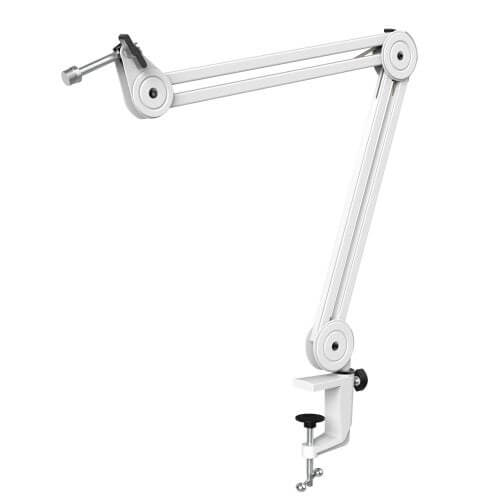
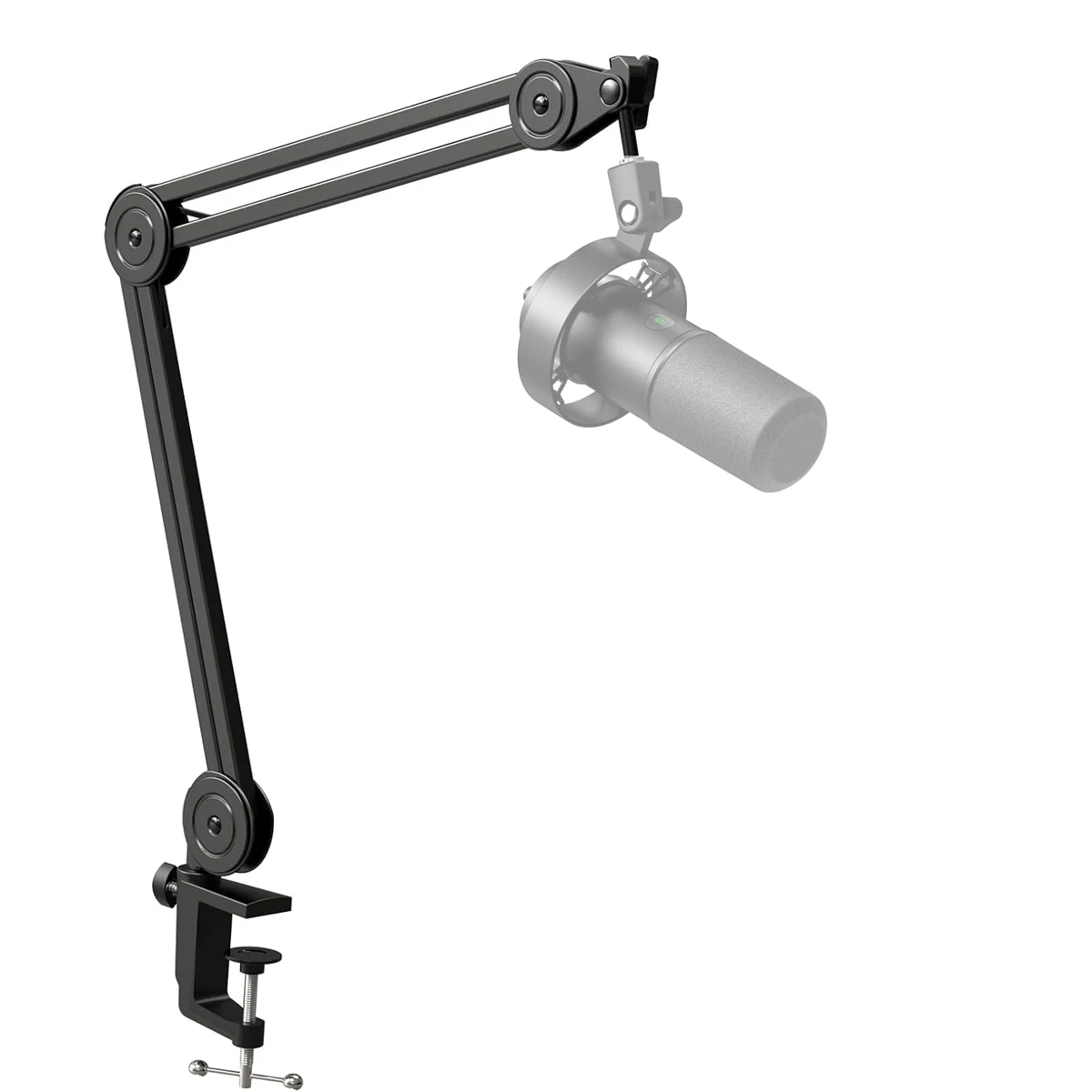
Fifine BM63 ($36) – a universal stand for USB microphones, an excellent affordable option for various tasks. Suitable as a holder for microphones, cameras, phones, lighting, etc.
Boom Arm Rating – 8/10. The boom arm has a sturdy and stable construction that does not require tool adjustment during use. The desktop microphone stand can also be mounted in an upper position. The desktop boom arm stand can support a load of 2 kg and can be used as a stand for a gaming microphone with accessories. The main drawback is a loose threaded connection. Fifine microphones are fixed perfectly, but microphones from other manufacturers may spin. The problem is solved by wrapping the thread or using an additional threaded adapter.
- Strong and reliable construction.
- Fixation of the pantograph in any position.
- The mount does not damage the surface.
- Withstands a load of 2 kg.
- Self-focusing position.
- Stand height 82.5 cm.
- Compatibility with all microphones with a 5/8" thread.
- Convenient for use, storage, and transportation.
- Stiff hinges, require some effort to change position.
- The set does not include adapters for microphones with a different mounting size.
- The mount is only suitable for flat surfaces.
- Microphones from other manufacturers may spin in the threaded mount.
4. Noname Microphone Stand
The most affordable microphone holder – a low-profile boom arm for a microphone
Microphone mount: spherical, adapter needed | Load: 0.5 kg | Length: 73 cm | Position fixation: self-fixing + handle on the body


Noname Microphone Stand ($12) – an affordable low-profile boom arm for a microphone. An excellent option as a first holder for a microphone, phone, tablet, or lighting.
Boom arm rating – 6.5/10. The holder is distinguished by its compact size and compatibility with most standard microphones. The low-profile boom arm can handle moderate loads, and the build and material quality are sufficient for regular use. The stand also features convenient adjustment and position fixation. The weakest aspect of the boom arm is its mediocre stability under load. The boom arm can support the weight of a microphone, but its position can shift up to 8 cm, requiring additional position correction.
- Low price.
- Convenient accessory mounting.
- Compatibility with most standard microphones.
- Durable construction.
- Convenient position adjustment.
- Mediocre quality and reliability of the mount.
- Mediocre stability.
- Withstands moderate load.
Frequently Asked Questions:
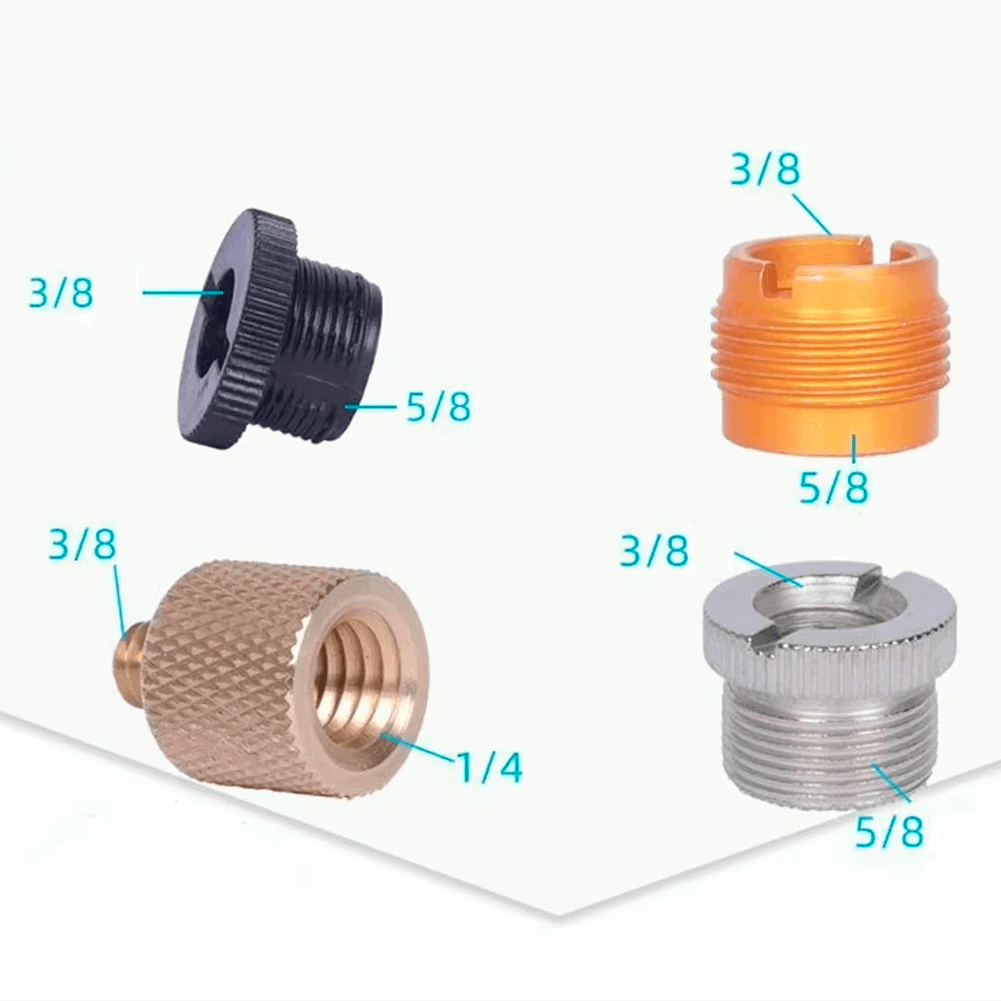
What types of microphone adapters are there?
How to choose a microphone pantograph?
When choosing a pantograph, consider these criteria: load capacity, microphone mount, and stand length. First, load capacity: the stand should handle 1 kg or more. Most microphones weigh 300-600 grams, and various accessories add to that. It’s important to choose a stand with a little extra load capacity. Second, microphone mount: the mic typically attaches via a threaded connection, sometimes with an adapter. The most common pantograph for mics has a 5/8-inch thread, compatible with most modern mics. Stands with 1/4” and 3/8” threads are less common and better for small USB mics, but any connection issue can be solved with an adapter. Third, stand length: select the maximum height based on your needs. For studio work, a standard studio mic stand up to 1.5 meters is suitable. A boom mic stand can reach 2.5–3 meters with its reach. For home use, 60-80 cm is usually sufficient.
What is a microphone stand called?
The most common name is ‘pantograph.’ You might also see it called a floor microphone stand, microphone stand, low-profile microphone stand, spider microphone stand, or microphone stand bracket.
How to install a microphone pantograph?
Usually, a pantograph has two parts: a desk mount and the frame. The mount should attach to your desk or another stable, flat surface. Then, install the stand in the connection point and secure it with a screw or manual clamp. A stand for a condenser mic is typically larger and might have extra parts like a counterweight or shock mount.
What types of microphone mounts are there for a pantograph?
Microphone mounts for a pantograph can be: 1. Threaded. 2. With a rigid or flexible clamp. 3. Magnetic. 4. Quick-release.
How do I know if a pantograph will fit my microphone?
In the pantograph’s specs, check the maximum load. This value should have a small margin above your microphone’s weight. If your mic is 300-600 grams, the stand should support at least 1 kg. Another factor is the mount type; most mics use a 5/8-inch threaded connection. If yours has a different connection, you’ll need an adapter.