

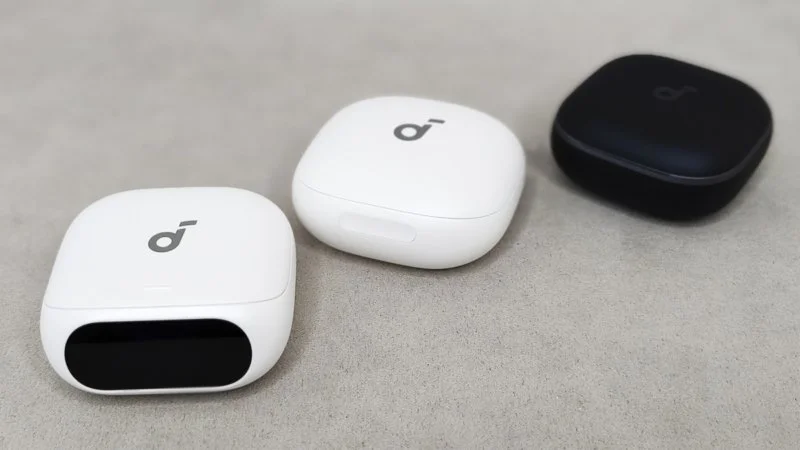
This is a ranking of the best wireless headphones from ANKER SoundCore tested at MyChooz. When it comes to SoundCore Bluetooth headphones, the focus is on features. The last flagship for sound was released in 2021 – the Liberty 3 Pro. In the true wireless earbuds Liberty 4 Pro, the balanced armature driver was replaced with a dynamic one, and the 5 Pro uses only a single dynamic driver. Therefore, both generations are noticeably inferior in sound to the 3 Pro. However, the headphones have improved in functionality, and the Liberty 5 Pro aims to be the benchmark for overall features.
ANKER SoundCore headphones are versatile and suitable for various tasks – music, calls, noise cancellation outdoors and in the office, mobile games, and light workouts. SoundCore headphones aren’t tied to an ecosystem, and you get access to all features without limitations. Each aspect can be rated above average or top-tier. The exception is the manufacturer’s budget models, which cut corners everywhere. If I had to highlight the main strengths, they would be: battery life, build quality and materials, active noise cancellation, and the microphone. SoundCore headphones also commonly use the LDAC codec.
The ranking doesn’t include the brand’s best model for sound – Soundcore Liberty 3 Pro, as the headphones have been discontinued. You can only buy the model as remaining stock in questionable stores or used from individuals.
About the ANKER SoundCore brand.
Learn moreAnker was founded in 2011 in China. The founder is Steven Yang, a former Google engineer. The company’s initial focus was on replacement batteries and chargers for phones and tablets. In 2018, it spun off its audio equipment line into a separate sub-brand, Soundcore, for wireless headphones and portable speakers.
In May 2026, the parent company changed its name to Anker Innovations. Under the Anker brand and its subsidiaries, various consumer products are released:
Anker — chargers and mobile accessories:
- Portable power banks
- Wall and wireless chargers
- Car chargers
- Charging and data cables
- USB hubs and docking stations
Soundcore — audio equipment:
- Wireless true wireless earbuds and headsets
- Over-ear and on-ear headphones
- Portable and home Bluetooth speakers
- Sports and bone conduction / open-fit earbuds
Eufy — home appliances and smart home:
- Robot vacuums and cordless stick vacuums
- Surveillance cameras, smart doorbells, and locks
- Smart scales and baby monitors
- Pet care devices
Nebula — projection equipment:
- Portable mini projectors
- Home laser and Smart projectors
Anker SOLIX — portable power and storage solutions:
- High-capacity power stations
- Portable and stationary solar panels
- Home energy storage and backup systems
AnkerWork — electronics for work and video conferencing:
- Webcams
- Speakerphones and conference microphones
- Office headsets
eufyMake / AnkerMake — creative devices:
- 3D printers and their consumables
- UV printers
Learn more about the LDAC codec: compatibility, real quality improvement, where the codec works, etc.
Learn moreCompatibility. The LDAC codec is the second most accessible audio codec on Android after AAC and SBC. With the LDAC codec, the sound is less compressed and more detailed, and the best sound quality is achieved with the “quality” preset at a bitrate of 909/990 Kbps. The codec appeared in Android 8.0 and is supported by all phones and tablets, except for some models where the manufacturer removed the codec from the system or the codec is hardware-locked. Therefore, in 99.9% of cases, an Android source is compatible with headphones that have the LDAC codec.
Impact on sound, expectation vs. reality. Often, some potential owners of headphones with the LDAC codec mistakenly believe the presence of the codec guarantees high-quality sound. The formula “source with LDAC” + “headphones with LDAC” = “high-quality sound” doesn’t always work. The codec acts as a “data packer,” and the better the codec’s parameters, the less data loss during unpacking. The sound system plays a key role: driver type and quantity, driver design, DACs and amplifiers, acoustic design, and other hidden parameters – software and hardware. If any element in this system doesn’t work correctly – due to cost-saving on components or design flaws – the codec’s efficiency decreases. What else? If the sound system can’t handle it, the codec won’t help.
Where does the LDAC codec work? Usually, the codec doesn’t work in headphones under $50, or the quality improvement is minimal. It’s more often noticeable in headphones $100+.
The quality improvement – and don’t be surprised – is more often noticeable in mid-range models and above. This is because the lower the production cost, the more limitations there are. At the same time, a high price for headphones isn’t always an objective indicator of potential quality; there are models with cheap production and high markups. And this markup usually goes into the pockets of company shareholders or is distributed among famous personalities from the music and film industries. Therefore, there are exceptions in models cheaper or more expensive.
Real improvement with LDAC codec. Based on my experience with tested headphones with different driver types and designs, the improvement ranges from 1-3% to 15-20%. This is an approximate value, as tests rely on listening. Devices for measuring quality haven’t been invented yet. At least, I haven’t encountered any.
It’s important to understand two main points. First, with the LDAC codec, you get an improvement in detail retrieval. Naturalness doesn’t improve, nor does the soundstage. The sound balance also doesn’t change.
Second, the percentage improvement varies for each pair of headphones. A 15-20% improvement in headphones with an overall score of 5-6 out of 10 is nowhere near comparable to a 3-5% improvement in headphones scoring 8-9. Therefore, when you notice a high improvement with the codec, it’s worth checking the overall sound score.
Which codec is better – LDAC or LHDC?
Learn moreLDAC is better in terms of availability, while LHDC is better in terms of capabilities.
| Maximum bitrate | Up to 990 kbps | Up to 900 kbps (V 3/4), up to 1000 kbps (v5) |
| Maximum frequency / Bitrate | 24 bit / 96 kHz | 24 bit / 96 kHz (v3/v4), up to 24 bit / 192 kHz (v5) |
| Bitrate control | 330 / 660 / 990 kbps, adaptive bitrate – 330-990 kbps. | 400 / 500 / 900 / 1000 kbps, adaptive bitrate – 128-1000 kbps. |
| Audio latency | ~160–200 ms | ~200 ms (there is an LLAC / LHDC LL low latency mode up to 30 ms |
| Android Integration | Native support with Android 8.0+ | Basic structure in AOSP with Android 10, native support v5 with Android 17 |
| Lossless mode | No | LHDC 5.0 claims lossless |
The characteristics of both codecs are comparable, with LHDC having an edge. More parameters are available for adjustment, higher sampling frequency, and there are LHDC lossless and low latency switches.
However, LDAC is far ahead in terms of prevalence. The codec appeared in Android version 8.0+, so you don’t need to worry about compatibility. More headphones in various price categories support LDAC. There are more USB adapters with LDAC support. For comparison, there are only 2 USB adapters for LHDC, and only one works without issues. Although in the future, LHDC may catch up to LDAC in prevalence and even surpass it. More flexible licensing and minimal royalty fees will quickly popularize the LHDC codec among manufacturers.
In terms of signal stability, both codecs are on the same level.
In terms of sound, both codecs provide the same quality, and you’d have to strain to hear the difference. This is if the headphones support both LDAC and LHDC. Therefore, you should focus on the sound system first, and then on the codec. More on codecs.
How to get the LDAC codec where it’s not supported?
Learn moreIf your headphones support the required codec, but your phone, tablet, or PC doesn’t, you can use a USB adapter. This device, about the size of a Bluetooth adapter, plugs into your phone or PC’s port. Then, connect your headphones to the adapter, and it will receive the signal with the appropriate codec.
Which adapter to choose?
- QCC Dongle Pro2 – if you want it all at once. The adapter supports: LHDC 5.0, LDAC, aptX Adaptive, aptX HD, aptX Lossless; LE Audio and Auracast are claimed.
- FiiO Air Link – a universal adapter, just cheaper. Codec support: SBC, aptX, aptX Low Latency, aptX HD, aptX Adaptive, LDAC, and aptX Lossless.
See our ranking for more on USB adapters — Best Bluetooth Adapters for Computers and Headphones.
EMMA — Experts + Methodology + MyChoozers + Algorithm.
Every model goes through identical tests; the score is calculated automatically with fixed weights — a spot in the rating cannot be bought.
TOP-3: Best ANKER SoundCore Wireless Headphones – Ranking
1. ANKER SoundCore Liberty 5 Pro 8.51TOP TRUE WIRELESS earbuds by functionality
Drivers are the drivers in your headphones that are responsible for creating sound.
DD + PM + BA – means that there are several different types of drivers in these headphones.
DD – “Dynamic Driver” dynamic driver (deep bass, natural sound).
PM – “Planar Magnetic Driver” planar driver (wide soundstage and fast response).
BA – “Balanced Armature Driver” armature driver (accuracy and detail retrieval).
BC – “Bone Conduction Driver” or bone-conduction driver, which transmits vibration to the body of the headphones, transmitting sound through the bone/cartilage to the inner ear.
LDAC – high quality, high speed (Sony).
SBC is the basic Bluetooth standard, low quality.
AAC – Apple standard, good quality, low latency.
aptX – Qualcomm standard, good quality, low latency.
LC3/LC3plus – new Bluetooth LE Audio codecs, efficient compression.
Codecs are audio compression formats that affect sound quality and latency.
Headphone battery life is the playback time without recharging, measured in hours. Manufacturers measure without active noise cancellation (ANC), at medium volume (50-70%) and usually with the AAC codec, as these parameters affect battery consumption. Actual time may vary from 1% to 50%, depending on volume, active noise cancellation features enabled, codec (LDAC or other) and environmental conditions (cold, hot). It is important to consider not only the claimed playback time, but also the charging time and fast charging support.
Bluetooth is a wireless data transmission standard.
Support for new audio technologies.
Improved connection stability.
Reduced power consumption.
In the SoundCore Liberty 5 Pro, the main focus is on features comparable to the benchmarks for each parameter. Collectively, the model stands out as a leader, following the Liberty 5 Pro Max. Therefore, if features are your priority, the Liberty 5 Pro or 5 Pro Max will suit you. The sound quality isn’t bad, just unremarkable. It provides comfortable background sound for everyday listening. The improvement compared to the Liberty 4 Pro is minimal, and the results of the 3 Pro are simply unattainable.
- Comfortable balanced sound.
- Reference-quality functionality.
- Comfortable fit.
- The sound is minimally better than the previous generation.
- The proprietary app uses up to 1.9 GB of RAM.
The final sound score is calculated using this formula:
Frequency balance + Detail retrieval + Soundstage + Natural timbre / 4 = Final Sound Score.
. 8.25 They stay traditionally bass-heavy, though you get less low-frequency quantity than in past generations. Out of the box, the sound isn’t boring or harsh, making for comfortable background listening that is moderately detailed and natural. Dragging the score down are a lack of clarity and a compressed soundstage. It feels a bit like attending a concert and listening from behind the backstage or sitting in the very last side seats. You get standard sound without critical flaws, moderately pleasant and melodic, especially once you mess with the EQ. The Liberty 5 Pro lands in the silver league of MyChooz.Read more.
Microphone – We assess speech transmission quality by testing the microphone in two main scenarios: quiet and noisy environments.
Quiet environment – This involves recording indoors with minimal background noise. Noisy environment – This means recording outdoors near a six-lane road with maximum traffic noise.
. 9.75 In quiet conditions: 9.5 In noisy conditions: 10 In quiet conditions, your voice sounds detailed and clear with minimal distortion. In noisy conditions with a handheld vacuum cleaner running in the background, your voice sounds unnatural and more processed. At the same time, background noise is isolated, and speech remains intelligible.Read more.
Overall feature score — this is the overall score for all device features. This score comes from individual feature ratings (battery life, controls, app, connection stability, and others) and shows how easy and smart the device is for daily use.
. 9.19 This is a strong suit of the earbuds, falling just slightly short of reference models across all metrics. The only downsides are the high RAM usage by the proprietary app, which takes up to 1.9 GB and averages 1.5 GB. That is a lot; for comparison, the app for Noble earbuds uses roughly 110 MB.Read more.
Final build quality score is the overall score for build quality and materials: comfort, durability, and design. It shows how nice the device is to hold and use, and how long it will last.
. 8.17 They feel sturdy, without visible defects, on par with the previous generation. The earbuds feature less gloss so fingerprints are minimally visible, while the case screen gets dirty more easily. The earbuds are comfortable, do not put pressure on your ears, and sit securely. The case and earbuds look good, and I liked the design.Read more.
2. Anker SoundCore Liberty 4 Pro 8.04Wireless headphones for Android phones — the most bass-heavy
Drivers are the drivers in your headphones that are responsible for creating sound.
DD + PM + BA – means that there are several different types of drivers in these headphones.
DD – “Dynamic Driver” dynamic driver (deep bass, natural sound).
PM – “Planar Magnetic Driver” planar driver (wide soundstage and fast response).
BA – “Balanced Armature Driver” armature driver (accuracy and detail retrieval).
BC – “Bone Conduction Driver” or bone-conduction driver, which transmits vibration to the body of the headphones, transmitting sound through the bone/cartilage to the inner ear.
LDAC – high quality, high speed (Sony).
SBC is the basic Bluetooth standard, low quality.
AAC – Apple standard, good quality, low latency.
aptX – Qualcomm standard, good quality, low latency.
LC3/LC3plus – new Bluetooth LE Audio codecs, efficient compression.
Codecs are audio compression formats that affect sound quality and latency.
Headphone battery life is the playback time without recharging, measured in hours. Manufacturers measure without active noise cancellation (ANC), at medium volume (50-70%) and usually with the AAC codec, as these parameters affect battery consumption. Actual time may vary from 1% to 50%, depending on volume, active noise cancellation features enabled, codec (LDAC or other) and environmental conditions (cold, hot). It is important to consider not only the claimed playback time, but also the charging time and fast charging support.
Bluetooth is a wireless data transmission standard.
Support for new audio technologies.
Improved connection stability.
Reduced power consumption.
SoundCore Liberty 4 Pro — the best wireless headphones for Android phones with enhanced bass. Main reasons to buy: pleasant low-frequency sound, good noise cancellation and microphone in quiet environments, convenient charging case with a screen. Downsides: lack of detail and naturalness in the mids, the screen on the case provides little information, and in our unit, battery loss for the earbuds was 30% over a year.
- Pleasant low-frequency sound
- Top-tier microphone in quiet environments
- Convenient screen on the case
- Over a year, battery capacity dropped to 30%
- Lacks detail and naturalness in the mids and highs
- The screen on the case is uninformative
The final sound score is calculated using this formula:
Frequency balance + Detail retrieval + Soundstage + Natural timbre / 4 = Final Sound Score.
. 7.88 With an emphasis on low frequencies and excessive fill. Bass slightly overpowers the mids, and the sound lacks transparency. Highs are bright with a lack of expressiveness. Detail retrieval is enough to make out the primary and secondary parts. The sound is moderately natural, with a bit of grain in the highs and boomy lows. The soundstage is slightly wider than the head with false width.Read more.
Microphone – We assess speech transmission quality by testing the microphone in two main scenarios: quiet and noisy environments.
Quiet environment – This involves recording indoors with minimal background noise. Noisy environment – This means recording outdoors near a six-lane road with maximum traffic noise.
. 8.00 In quiet conditions: 9.5 In noisy conditions: 6.5 In quiet environments, the SoundCore Liberty 4 Pro microphone performs flawlessly. In very noisy conditions near the road, software noise cancellation cuts out a lot of words.Overall feature score — this is the overall score for all device features. This score comes from individual feature ratings (battery life, controls, app, connection stability, and others) and shows how easy and smart the device is for daily use.
. 8.33 Active noise cancellation works well for office and outdoor use, and transparency mode makes chatting with the wireless earbuds in convenient. Battery life is up to 10 hours and 40 hours with the charging case. However, after 7 months of periodic testing use, the battery capacity in the wireless earbuds dropped to 50% — 4-6 hours considering the codec. Touch controls feature 5 actions per wireless earbud, and you can adjust ambient settings through the screen on the charging case. The companion app features custom sound tuning, a voice assistant, and a translator, without being tied to the wireless earbuds manufacturer.Read more.
Final build quality score is the overall score for build quality and materials: comfort, durability, and design. It shows how nice the device is to hold and use, and how long it will last.
. 8.00 The wireless earbuds are comfortable, with no discomfort after three hours of use. No complaints about build quality and materials, except for a slight hinge wobble on the lid. The wireless earbuds look generic, but the charging case looks better. Available in 4 colors.Read more.
3. Anker Soundcore Liberty 5 7.46Best noise-canceling headphones under $150
Drivers are the drivers in your headphones that are responsible for creating sound.
DD + PM + BA – means that there are several different types of drivers in these headphones.
DD – “Dynamic Driver” dynamic driver (deep bass, natural sound).
PM – “Planar Magnetic Driver” planar driver (wide soundstage and fast response).
BA – “Balanced Armature Driver” armature driver (accuracy and detail retrieval).
BC – “Bone Conduction Driver” or bone-conduction driver, which transmits vibration to the body of the headphones, transmitting sound through the bone/cartilage to the inner ear.
LDAC – high quality, high speed (Sony).
SBC is the basic Bluetooth standard, low quality.
AAC – Apple standard, good quality, low latency.
aptX – Qualcomm standard, good quality, low latency.
LC3/LC3plus – new Bluetooth LE Audio codecs, efficient compression.
Codecs are audio compression formats that affect sound quality and latency.
Headphone battery life is the playback time without recharging, measured in hours. Manufacturers measure without active noise cancellation (ANC), at medium volume (50-70%) and usually with the AAC codec, as these parameters affect battery consumption. Actual time may vary from 1% to 50%, depending on volume, active noise cancellation features enabled, codec (LDAC or other) and environmental conditions (cold, hot). It is important to consider not only the claimed playback time, but also the charging time and fast charging support.
Bluetooth is a wireless data transmission standard.
Support for new audio technologies.
Improved connection stability.
Reduced power consumption.
Main reasons to buy: a bass-heavy model with versatile sound settings in the proprietary app. Top-tier noise cancellation and battery life, and the microphone is on par with the best. Includes a proprietary voice assistant and translator. Downsides – mediocre sound quality comparable to budget models.
- bass-heavy model with customizable sound settings in the companion app
- Top-tier noise cancellation and microphone
- Top-tier battery life
- Mediocre sound on par with budget models
The final sound score is calculated using this formula:
Frequency balance + Detail retrieval + Soundstage + Natural timbre / 4 = Final Sound Score.
. 6.50 The earBuds FEature clear vocals and highs. There’s some artificiality and grainy treble, but it isn’t as accentuated during background listening. The impression is spoiled by the bloated bass. Low frequencies are overly accentuated, and vocals and instruments sound unnatural.Read more.
Microphone – We assess speech transmission quality by testing the microphone in two main scenarios: quiet and noisy environments.
Quiet environment – This involves recording indoors with minimal background noise. Noisy environment – This means recording outdoors near a six-lane road with maximum traffic noise.
. 8.25 In quiet conditions: 9 In noisy conditions: 7.5Overall feature score — this is the overall score for all device features. This score comes from individual feature ratings (battery life, controls, app, connection stability, and others) and shows how easy and smart the device is for daily use.
. 8.58 Noise cancellation is on par with top models. You can converse in transparency mode. Battery life in our tests reached up to 12 hours for the earbuds and 48 hours with the charging case, taking the codec into account. Stem-pinch controls feature rare false triggers and occasional glitches with play/pause operation. The app is convenient and slightly overloaded with features.Read more.
Final build quality score is the overall score for build quality and materials: comfort, durability, and design. It shows how nice the device is to hold and use, and how long it will last.
. 8.17 Comfortable and does not cause fatigue after a couple of hours of use. No complaints about build quality and materials, with the only weak point being the sliding case lid. The plastic of the earbuds and the case is a fingerprint magnet, easily collecting smudges. The earbuds look good and are available in 4 colors.